Showing posts with label Clay Share. Show all posts

Sunday, February 15, 2015

"Book of Tea", Peter Hamann, "Snowflake" Bentley

Tuesday- Clay Share 
"The Book of Tea"
"The Book of Tea", by Okakuzo Kakuzo
In 1906, Okakura Kakuzo wrote "The Book of Tea” for the western audience. He wrote this philosophical essay in english, and it focuses on the role of tea (teaism) to the aesthetic and cultural aspects of Japanese life. This book has been printed many times since 1906 with the most recent printing in 2010 and an expanded edition in 2011. Our copy was printed in 1926. You can download this book onto your tablet via the Gutenberg Project

This year's North Carolina Potters Conference​ will include a portion of the Tea Ceremony on Saturday afternoon and a presentation on Thursday morning titled  "The Japanese Tea Bowl, Context & Perceptions" by Peter Hamann. Peter will be assisted by Shizuko Kohara for the Saturday Tea Ceremony, both are Tea Masters.

"The Book of Tea", by Okakuzo Kakuzo


Thursday - Potters Pick
Peter Hamann
Tea Caddy made by Peter Hamann, Sasayama, Japan
Peter Hamann says "no matter what type of piece I make, my deepest wish and highest goal is to make pieces that people will enjoy viewing and using as much as I enjoy making them." Peter specializes in celadon porcelains... making forms including carved vases, covered jars, tea caddies, and tea bowls. Peter is a Tea Ceremony master and travels to Osaka weekly to study, and he puts on several major Tea Ceremonies a year. Mr. Peter Hamann is a native of Nebraska and has called Japan his home since the early 80's.  

Peter will be a demonstrator for the upcoming North Carolina Potters Conference, Asheboro, NC, March 6-8, 2015. Peter will also be conducting a Tea Ceremony Saturday afternoon. A very special treat for all those that attend the three day conference with optional bonus day at STARworks on March 5, 2015. Registration is filling up fast!   #NCPottersConf 
Peter Hamann, Sasayama, Japan


Sunday - Playing off the Instrument
"Snowflake Bentley"
Wilson A. Bentley (1865-1931)
No two snowflakes are alike----- This discovery was made in the small rural town of Jericho, Vermont by Wilson A. Bentley (1865-1931).

"Under the microscope, I found that snowflakes were miracles of beauty; and it seemed a shame that this beauty should not be seen and appreciated by others. Every crystal was a masterpiece of design and no one design was ever repeated., When a snowflake melted, that design was forever lost. Just that much beauty was gone, without leaving any record behind.".....Wilson "Snowflake" Bentley 1925

Wilson A. Bentley (1865-1931)
We post our: Clay Share - Tuesday,
Potters Pick - Thursday,
Playing off the Instrument - Sunday

Sunday, January 25, 2015

Tsuchi-Aji, Sandy Simon, Anna Atkins

Tuesday - Clay Share
 Tsuchi-Aji - The Taste of Clay 
Richard Bresnahan - Minnesota Potter


 This video is about Richard Bresnahan, a potter from Minnosota, who apprenticed with the Nakazato Family in Japan for four years in the 1970's. Upon his return he built a large wood-firing kiln and collected 18,000 tons, a few life-times supply of a local clay, and had the clay brought to Saint Johns University.  Richard Bresnahan was the first artist-in-resident at St John's University, and presently he directs the pottery studio on the campus of Saint John's, a Benedictine abbey and university in the woodlands of central Minnesota. 

The Taste of Clay-- Tsuchi-Aji

"Tsuchi-Aji, or the'flavor' of the clay. Aji (flavor or taste) is a very common concept in Japanese that is often difficult to translate to English. In Japanese "it has flavor" can be said of food, people, or pottery. Pottery without 'flavor' is superficial. Pottery with 'flavor' is worth savoring."  Peter Hamann a potter from Japan, and demonstrator at the upcoming North Carolina Potters Conference will be discussing this philosophy with fellow presenters and the audience in Asheboro, NC, on March 6-8, 2015. A bonus day has been added to the Potters Conference this year at STARworks on March 5 in Star, NC. 

Thursday - Potters Pick
Sandy Simon
Sandy Simon, California, TRAX Gallery
Sandy Simon is a studio potter and in 1994 opened TRAX Gallery in Berkeley, CA to provide greater representation for ceramicists dedicated to utility. Simon keeps her forms minimal, thus highlighting the landscape of a form, the detailed addition of wire handles, or subtle alterations including cutting, piercing, seeds, and thread.

Sandy Simon feels, "A pot made by hand suggests the spirit of the potter, and the thought &  considerations that goes into the making of it reveals the energy of the human condition.”

Sandy Simon will be speaking at this year's North Carolina Potters Conference, on March 5-8, 2015. The North Carolina Potters Conference is hosted by the Randolph Arts Guild in Asheboro, NC. This year the focus will be on Japan.  We have three potters from Japan demonstrating on stage Friday and Saturday and a very interesting line-up of talks Sunday morning. There is a bonus day on March 5 at STARworks in Star, NC. Online registration is now open at he Randolph Arts Guild website.  #NCPottersConf

Sandy Simon, California, TRAX Gallery

Playing off the Instrument - Sunday
Anna Atkins
Anna Atkins, image from the Notebook-Natural History blog
Anna Atkins was a botanical illustrator and naturalist in the 1800’s. She printed and published Part I of the 12 part “British Algae: Cyanotype Impressions” in 1843 which contains over 400 images. She learned the cyanotype process from Sir John Hershel, a family friend, even the words were written using the cyanotype process.

Please read more about Anna Atkins and her life and work at the Venetian Red website. 

Anna Atkins

We post our: Clay Share - Tuesday,
Potters Pick - Thursday,
Playing off the Instrument - Sunday

Sunday, January 18, 2015

Hippopotamus, Quiet Inspirations, Meadham Kirchhoff

Tuesday - Clay Share
Statuette of a Hippopotamus
 Hippopotamus, Middle Kingdom, 1981–1885 B.C. Egyptian; collection of Metropolitan Museum of Art
It is easy to get a warm and fuzzy feeling when looking at this Hippopotamus sculpture. After reading about it we find out the Hippopotamus was a dangerous animal to the Egyptian people, and was one animal that they kept a keen wary eye out for as they fished the waterways.  This turquoise hippo was found in a tomb with three of its legs broken, to prevent the creature from harming the deceased in the afterlife. The legs were repaired after its discovery as part of a burial tomb.

Egyptian faience is a self glazing ceramic paste that goes back 7,000 years ago. It is primarily silica with fluxes added as soluble salts. As the material drys, the salts collect at the exposed  surface as the water evaporates. Copper is added to the material to obtain the turquoise color. When fired, a glaze develops at the surface where the fluxing salts have become concentrated, and the silica mass becomes fused.  This process is a transitional technology between glass and glazed clay objects.  Essentially it is a glass material worked as a paste rather than as a material in a molten state, and then sintered, rather than fully melted.
Contemporary Egyptian paste formulas have for the most part been adjusted to contain enough clay and other materials to make them more plastic than the original faience formulas, making them easier to work with.
This Egyptian Hippopotamus is in the collection at the Metropolitan Museum of Art.  Amy Waller Pottery has further information on her blog Amy Waller Pottery. Also there is an interesting article about Faience by K. Kris Hirst.


Hippopotamus, Middle Kingdom, 1981–1885 B.C. Egyptian; collection of Metropolitan Museum of Art

Thursday - Potters Pick
Judith Duff
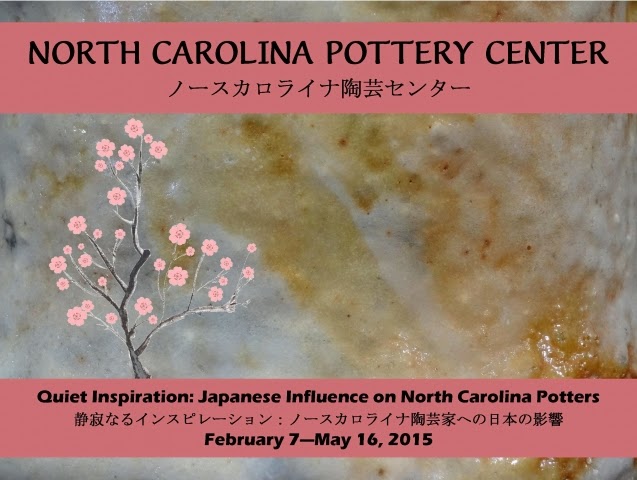
Quiet Inspiration: Japanese Influence on North Carolina Potters - at the North Carolina Pottery Center, Seagrove, NC
Judith Duff, a potter from Brevard, NC. is the curator for the upcoming "Quiet Inspirations: Japanese Influence on North Carolina Potters" at the North Carolina Pottery Center, in Seagrove, NC. Opening Reception is on Saturday, February 7, 2015 from 12:00—2:00 p.m.

There will be a presentation by Judith Duff at the North Carolina Pottery Center on March 8, 2015 Sunday, 2:00 pm. right after the North Carolina Potters Conference. For more information about the exhibition visit the North Carolina Pottery Center and for more information about the North Carolina  Pottery Conference visit the Randolph Arts Guild. 

Quiet Inspiration: Japanese Influence on North Carolina Potters - at the North Carolina Pottery Center, Seagrove, NC

Playing off the Instrument
Meadham Kirchhoff


Meadham Kirchhoff  - Edward Meadham and Benjamin Kirchhoff - Teamwork

Break out the under-glaze, over-glaze, and lusters; grab you some bright mason stains, … it's time to compete with confections as rich as these, and shed our self imposed ceramic aesthetic proprieties.


We post our: Clay Share - Tuesday,
Potters Pick - Thursday,
Playing off the Instrument - Sunday

Sunday, January 11, 2015

To Twist or to Turn, Yoshiki Onoyama, Beauty and the little woolly Beasty

Tuesday - Clay Share - To Twist or to Turn  

Thrawan a pot
If we want to be traditional about what we call making a pot on the potter’s wheel, maybe we should call it thrawan….which means to twist or to turn.

   To twist or to turn.... some folks say they throw their pots and others say they turn their pots....maybe we should be saying we are thrawan pots.  Find out why... see the article "Why On Earth Do They Call It Throwing?", by Dennis Krueger.

Thrawan a pot

Thursday - Potters Pick: Yoshiki Onoyama

Yoshiki Onoyama

For the next few weeks we will be featuring the demonstrators and the presenters that will be a part of the upcoming North Carolina Potters Conference, in Asheboro, NC hosted by the Randolph Arts Guild on March 6-8, 2015.  This year we are lucky to have a visiting artist here at the same time at STARworks.  We have included a **bonus day** on March 5, at STARworks in Star, NC.

Yoshiki Onoyama teaches at the Okayama University in Japan. He is an accomplished potter and has a deft hand when decorating his porcelain ceramics. His technique, Sometsuke (Blue paint on porcelain), stamp and inlay decorations are beautifully executed.  

March 5, 2015 - Thursday – **BONUS DAY**

PLEASE NOTE – This day’s events will be hosted at STARworks in Star, NC.

**A separate Registration Fee of $50 to attend – Look for it on the registration form**
Thursday March 5
8:00 Registration
9:00 Introductions
9:45 Shizuko Kohara - Shigaraki
10:30 Break
11:00 Peter Hamann – The Japanese Tea Bowl, Context and Perceptions
11:45 Slide Presentation – Yoshiki Onoyama
12:15 Lunch
1:30 Demonstration – Yoshiki Onoyama
-------
6:00 Networking / Social Hour – Sponsored by Rising Sun Pottery  – Open to all conference attendees and will be held at the Randolph Arts Guild.  

Yoshiki Onoyama


Sunday - Playing off the Instrument -  Beauty and the little woolly Beasty

Borneo Pitcher Plant,  Nepenthes rafflesiana elongata and woolly Bat -  Photo Credit Holger Bohn
We are fascinated by symbiotic relationships, a mutualistic relationship when two organisms of different species "work together," each benefiting from the relationship.  This particular mutual relationship is between a small woolly bat and a carnivorous pitcher plant which was found on the southeast Asian island of Borneo.  The pitcher plant provides a perfect room for the Bornero bat to take shelter in, and in return the plant benefits from the nutrients in the bats' droppings.

In 1970 I had a job when I was in high school, working for the entomology and biochemistry departments of Oklahoma State University collecting spiders. Part of the job was to drive out into the country side to find fields that looked promising as tarantula habitat. When we found a likely location, we would hunt and frequently find colonies of tarantulas that nested in individual burrows in the ground, usually many yards apart. To collect the tarantula, we used a spade and a coat hanger wire as a probe to locate and coax the spider out with. One would gently fish into the hole with the wire until an aggressive tapping on the wire would signal the presence of the tarantula defending its realm, at the same time one could determine how deep in the ground the spider was. A spade full of dirt would then be removed, determined by that depth, and the process repeated until.....out popped a..... greasy grey toad!
This didn't happen every time, but frequently the tarantula would share its burrow with this particular small smooth grey species of toad. It wasn't until just recently that I found out more about who this toad was, and Odd Couple indeed.


We post our: Clay Share - Tuesday,
Potters Pick - Thursday,
Playing off the Instrument - Sunday

Sunday, January 4, 2015

Apothecary Albarello, Bernard Palissy, Karl Blossfeldt

Clay Share - Tuesday
Apothecary Albarello
Spanish - Tin Glazed Earthenware - second half 15th century - in the Collection of Metropolitan Museum of Art
The Apothecary albarello, was designed to store herbs, powders, and other dry medicines and became popular shapes for pharmacy jars, partly because they were easily grasped when lined up close together on a shelf.

Wow, wouldn't that pharmacy be out of sight and a delightful visage. We would love to be able to see so many Albarellos all lined up along the shelves and in use.

The Metropolitan Museum of Art has somewhere around 130 different albarellos featured on their website from Spain, Italy, and the Middle East.

We ventured on a 2 week trip to London, back around 2006, and walked the entire British Museum. During our visit to London the Victoria and Albert Museum's floor of ceramics was closed because of two previous occurrences the year before our scheduled trip. Their ceramics cases were broken into two different times, and Meissen figurines were stolen. Bummer.  Below is an image of a few albarellos that we saw while visiting the British Museum.

An assortment of a few Albarellos in the British Museum, London


Thursday - Potters Pick
Bernard Palissy
Bernard Palissy, French, Paris, 18 7/8 x 14 1/2 in., about 1550, collection of Getty Museum
Bernard Palissy was unusual in his time, partly for his questioning of the common perception of where fossils came from, and also for his approach to clay.  His use of molded animal and plant images, many directly from life, became influential to many other ceramicists creating a stylistic following known as Pallissy wares that persisted over the years. Charles-Jean Avisseau of Tours, rediscovered Palissy's techniques in 1843 creating a resurgent Palissy movement in France, and there was a particularly strong group making Palissy wares in Portugal from the 1850's persisting into the early 1900's. 

There are a couple of websites that we ran across that wrote about Palissy and his life that are interesting reads. One article was "Bernard Palissy – the Protestant potter who died in the Bastille" on a website called Look and Learn. Another article is simply titled "Bernard Palissy" can be found on a website called Strange Science. We are looking forward to delving into this website a little more.  It explores some of the beginnings of scientist's discoveries and states "Ever wonder how people figured out there used to be such things as dinosaurs? Curious about how scientists learned to reconstruct fossil skeletons? The knowledge we take for granted today was slow in coming, and along the way, scientists and scholars had some weird ideas." 

The Bernard Palissy images shown here are from the J Paul Getty Museum and the Metropolitan Museum of Art.

Attributed to Bernard Palissy, Paris, about 1550 18 7/8 x 14 1/2 in., collection of Metropolitan Museum of Art


Sunday - Playing off the Instrument
Karl Blossfeldt

Karl Blossfeldt, image from Sage Ross blog, part of a group of Kindle screensavers
The book "Karl Blossfeldt, 1865-1932" by Hans-Christian Adam, is seminal in our library.
Karl Blossfeldt's photographic work of organic shapes- stems, flower buds, tendrils, seed pods… is truly a wonderful inspiration for pottery form and surface. It sparks the imagination and leads the mind to fantastical places. In the magazine "Aperture", Sarah James writes an article titled "Karl Blossfeldt at the Whitechapel Gallery"

On the blog ragesoss by Sage Ross he has grouped together 17 different Karl Blossfeldt photographs as Kindle Screen Savers for you to download.  

Karl Blossfeldt, image from Sage Ross blog, part of a group of Kindle screensavers


We post our: Clay Share - Tuesday,
Potters Pick - Thursday,
Playing off the Instrument - Sunday
weekly on our Bulldog Pottery Facebook Page

Sunday, December 28, 2014

North Carolina Potters Conference, Théodore Deck, Zoom Quilt

Clay Share - Tuesday
 The 28th North Carolina Potters Conference 


The North Carolina Potters Conference is hosted by the Randolph Arts Guild in Asheboro, NC every year during the first full weekend of March.  We have been attending the conference since we moved to Seagrove. It is three days chuck full of ideas, techniques, and comradeship. It is a really good time, and is great for all levels of clay experience.

The 28th North Carolina Potters Conference (March 6-8, 2015) registration is now open. This year the conference features artists from Japan... with a bonus day on Thursday, March 5, at STARworks in Star, NC and an exhibition at the North Carolina Pottery Center, Seagrove, NC, curated by Judith Duff.

On Friday and Saturday there are three pottery demonstrators: Yoshitaka Hasu, Fuku Fukumoto, and Peter Hamann, up on stage making work concurrently. On Friday evening after dinner there is an opening presentation (this year it will be Sandy Simon), and Sunday morning there are three 45 minute talks. Lunch and dinner meals are included and Saturday evening is a real treat getting to see Dwight Holland's incredible pottery collection.


Potters Pick - Thursday
Théodore Deck
Théodore Deck Urn, image from Christies
 Given the strong revival of interest in surface design for ceramics, Théodore Deck set a great precedence. A passion for researching and experimenting, Théodore Deck, was part of a group of avant-garde French ceramicists creating ceramic art at the end of the nineteenth century.

Théodore Deck knew how to turn his passion for researching ceramic materials and glazing into elegant refined objects of art. He designed and made beautiful pottery with intricate layers of lush surface effects.

Théodore Deck, worked as an independent studio potter establishing his shop in Paris in 1856, and became the director of the Sèvres Ceramics Factory in 1888. There is a wonderful selection of pottery on Google Images for Théodore Deck, where you can see a wide selection of his ceramics.

The pottery images I included on this blog where found on the following websites: The Urn, Christies, the Vase, Aspire Auctions, and the Bowl, Live Auctioneers.

Théodore Deck drew heavily from middle eastern ceramics for inspiration. On Ceramics Today you can read more about Théodore Deck in an article by Frederica Todd Harlow called "Théodore Deck and the Islamic Style".

Théodore Deck Vase, image from Aspire Auctions

Théodore Deck Bowl, image from Live Auctioneers


Playing off the Instrument - Sunday
The Zoomquilt
Screenshot from the Zoomquilt - collaboration of artists in 2007
The Zoom Quilt is a collaboration of artists from 2007, a surrealistic creation that follows along the lines of the 1977 film, "The Powers of Ten" by Charles and Ray Eame.

Hints on how to make the most of your ZoomQuilt experience: You can take the slider that is on the left and move it to the right to go forward and left to go backwards in the painting. You can also make the speed go faster, slower, or pause if you would like to look at the details. Once you set your desired speed you can hover your cursor on the right of the drawing to view the full journey.

Screenshot from the Zoomquilt - collaboration of artists in 2007

We post our: Clay Share - Tuesday, 
Potters Pick - Thursday, 
Playing off the Instrument - Sunday 

Sunday, December 21, 2014

Portuguese Wood-Fired Clay Oven, Harrison McIntosh, Microcosmos

Clay Share -Tuesday
Building a Portuguese Wood-Fired Oven


We are intrigued by the way the men in this Portuguese clay factory manipulate the clay to construct their clay ovens.

Potters Pick - Thursday
Harrison McIntosh
Harrsion McIntosh, In the Collection of the Alfred Museum, Bowl, h: 3-3/4”, Corsaw Collection.
When I was an undergrad at Alfred University, this bowl, made by Harrison McIntosh was on display on its own pedestal under a vitrine.  This bowl is beautiful and mysterious to me. The glaze soft, and the design a complex circle composition of inside/outside color play. I am enamored by the way the color on the inside reflected the halo color around the dots on the outside. This is a small intimate bowl, one that you can cradle in the palm of your hands.

Through the years, since my first introduction to this bowl, I have often thought of it and would see the bowl printed in a couple of Alfred's newsletters. I was reacquainted with it while touring the collections at the The Schein-Joseph International Museum of Ceramic Art this past summer when we were at Alfred. It was like being reunited with an old buddy of mine.

Born in 1914, Harrison McIntosh celebrated his 100th birthday this year with a special exhibit at the American Museum of Ceramics Art.  Watch a short interview of Harrison and his wife as they visit with some of the pots in his solo exhibition at the AMOCA museum.  Harrison McIntosh says,  "he makes work to please himself, what he finds beautiful. Every piece he made was the best that he could do."
Harrison McIntosh


Playing Off the Instrument
Microcosmos

The 1996 French documentary, Microcosmos, was filmed by Claude Nuridsany and Marie Perennou  covering an insect's world in a 24 hour day from dawn to dawn.  The tag-line was "Jurassic Park in your own backyard". Written in The "Wondrous Truth" of Microcosmos, by Billy Budd Vermillion, he describes this film as a "poetic" documentary.

While scanning the internet about Microcosmos we found a document of class notes called A Non-Entomologist's Guide to "Microcosmos", by Marina Caillaud and Bryan Danforth- Department of Entomology at Cornell University. This paper gives a blow by blow of the insects that appear in the documentary.

There were two promo introductions for the film to choose. I love the one showing the early morning rain storm.  There is nothing like droplets of rain hanging off an insect's exoskeleton. The other Microcosmos footage has an amazing visual of a bee buzzing through the air.


We post our: Clay Share - Tuesday, 
Potters Pick - Thursday, 
Playing off the Instrument - Sunday 


Sunday, December 14, 2014

Luke Syson, Karen Karnes, World Science

Clay Share - Tuesday
Luke Syson - Ted Talks


Excerpt from "How I learned to stop worrying and love "useless" art" filmed October 2013.
..... "Luke Syson was a curator of Renaissance art, of transcendent paintings of saints and solemn Italian ladies — serious art. And then he changed jobs, and inherited the Met's collection of ceramics — pretty, frilly, "useless" candlesticks and vases. He didn't like it. He didn't get it. Until one day … (Filmed at TEDxMet.)"

The two vases (vase à tête d'éléphant) were made by the Royal Sèvres Manufactory, made of porcelain in the late 1750s, and designed by the designer Jean-Claude Duplessis. These vases are in the collection of the Metropolitan Museum of Art
(Courtesy the Metropolitan Museum of Art, Gift of Samuel H. Kress Foundation, 1958)

Potters Pick - Thursday
Karen Karnes
Karen Karnes - A photo still from the movie "Don't Know, We'll See" Movie by Lucy Pheonix
Born in 1925, Karen Karnes has had a very full life of making pots and engaging in the Ceramic Art World.  A long pottery career and a passion for ceramics, she has paved a path for many studio art potters. She recently celebrated her 40th year curating the The Art School at Old Church Pottery Invitational in Demarest, NJ. She established this event with Mikhail Zakin (1920-2012) a friend, fellow potter and the founder of the Art School at Old Church, Demarest, New Jersey in 1974.

Mark Shapiro edited "The Chosen Path" a book about Karen Karnes that includes an introduction by Mark Shapiro, a foreword by Garth Clark, and narratives by Christopher Benfy, Jody Clowes, Janet Koplos, Edward Lebow, and Karen Karens. Mark also conducted an oral interview with Karen Karnes for the Smithsonian Archives of American Art.

Beginning in 1997 there was a film produced about Karen Karnes by Lucy Pheonix. This documentary of Karen Karnes is called "Don't Know, We'll See".

The Salt Glazed Covered Jar, made by Karen Karnes in 1969 is in the collection of AMOCA (Gift of James W. and Jackie Voell), The American Museum of Ceramic Art, located in Pomana, California.
Karen Karnes, Covered Jar, 1969, Salt Glazed, stoneware, cone 11, in collection of AMOCA

Playing off the Instrument - Sunday
18 Mind-Blowing Images From The World Of Science
Photo by Stefan Eberhard 
The photo above is by Stefan Eberhard, an image of an Arabidopsis thaliana flower, commonly known as thale cress.

Excerpt from Fast Company blog titled Fast Co.Design.... 
"The annual award celebrates the intersection of science and art, reminding us that the best visual inspiration often comes from the shocking beauty of the natural world."

...."The images will be added to Wellcome's vast collection of more than 40,000 science images, culled from researchers, clinical photographers, and illustrators, which are available freely to the public. "

The Wellcome Images is one of the world's richest and most unique collections, with themes ranging from medical and social history to contemporary healthcare and biomedical science.

You can see and read about the 18 award winning images at the Wellcome Images Award 2014.

Below is an image by Spike Williams of a Lagena, a class of marine protists with an external shell, made using ‘Spikeberg’ illumination, a combination of polarised light and Rheinberg illumination pioneered by the photographer, and captured on a Canon EOS 5D Mark II camera.

Photo by Spike Williams
We post our: Clay Share - Tuesday, 
Potters Pick - Thursday, 
Playing off the Instrument - Sunday 

Sunday, December 7, 2014

Studio Potter, John Gill, Xiphactinus

Clay Share - Tuesday
The Studio Potter

Studio Potter Magazine
Have you ever wondered what periodicals potters read?  The Studio Potter magazine is one of those 'must subscribe to' magazines for us.  Focused on aesthetic philosophy and the working potter with an "essential belief in functional pottery," The Studio Potter began in 1972 and is published twice a year. The articles are written by potters, sculptors, curators, and clay enthusiasts.  A theme is proposed and a deadline set for articles submitted to the publisher.

We have collected just about all of the The Studio Potter journals. We are missing a couple of them including the first Studio Potter that was published.  When you become a member you also get the chance to select one back issue.

Studio Potter Magazine

Potters Pick - Thursday
John Gill
Masters : John Gill - photo by Matt Wittmeyer - Amercian Craft Council 
John Gill is a superb teacher and ceramics artist with a gift for transmitting the unconventional possibilities of ceramics and form. John's generous sharing of his unique visions for the potentiality of clay creates a contagious enthusiasm for anyone brave enough to be open to what he can convey.

We had a wonderful time this past July, when we took a summer school class with John Gill at Alfred University. If you want to recharge your creative batteries for ceramics, it would be hard to do better than attending one of Alfred University's "Summer Ceramic Art" classes.

Find out more about John Gill and the other American Craft Council Masters on the American Craft Council Website


Playing off the Instrument - Sunday
Xiphactinus Audax
Lora Robins Gallery of Design and Nature
 Richmond, Virginia

Xiphactinus Audax at the Lora Robins Gallery
Located in Richmond, Virginia, The Lora Robins Gallery is a museum that bridges the arts and natural sciences. This museum is chuck-full of fossils, shells, minerals, and all kinds of interesting artifacts. It also has ceramics! We were in heaven when we visited the large room filled with curiosities.

 You can visit the museum on the campus of the University of Richmond. It has in its collections 100,000 pieces ranging from Jurassic dinosaur fossils, minerals, prehistoric shells, fluorescent rocks, and Chinese ceramics. One of the objects that we fell in love with was a fish fossil which was discovered in Kansas. The Xiphactinus is the largest bony fish in the Western Seaway reaching as much as 17 feet in length. Wow!

Xiphactinus Audax at the Lora Robins Gallery
We post our Clay Share - Tuesday, 
Potters Pick - Thursday, 
Playing off the Instrument - Sunday